
Web design, client project
Dogs N Buns: A Bold Bilingual Website for an American Fast-Food Shop
Big flavor. Built your way.
A bold, dark, high-energy bilingual website for an American fast-food shop in Pyeongtaek, built around a full menu and a build-your-own hotdog experience.
Services
- Web Design
- Restaurant
- Bilingual (EN/KO)
- Responsive
- Client Project
Technologies
- Next.js
- React
- TypeScript
- Tailwind CSS
- Playwright
- Vitest
- Work
- Website redesign & rebuild
- Completed
- October 2026
- Role
- UI/UX design, front-end development and bilingual content structure.
01 · Overview
Overview
Dogs N Buns serves American-style hotdogs, sliders, wings and loaded fries near Camp Humphreys in Anjeong-ri, Pyeongtaek, South Korea. Its audience includes English-speaking visitors and Korean locals. The website needed to give both groups a clear way to explore the food and plan a visit.
The project grew from menu design work for this Fiverr client. After reviewing the existing website, I offered a redesign and rebuild. My role covered UI/UX design, front-end development and bilingual content structure, connecting the menu work with a more complete digital presentation.
02 · The challenge
The challenge
The previous website did not match the energy of the brand, and its large menu was difficult to browse. A guest needed to understand the range of food without losing their place among options, toppings and sauces. The late-night opening hours also made clear visit information especially important.
English and Korean needed to be part of the main experience rather than a translation added at the end. The challenge was to keep the same food choices, customization guidance and location information understandable across both languages and on smaller screens.
03 · The approach
The approach
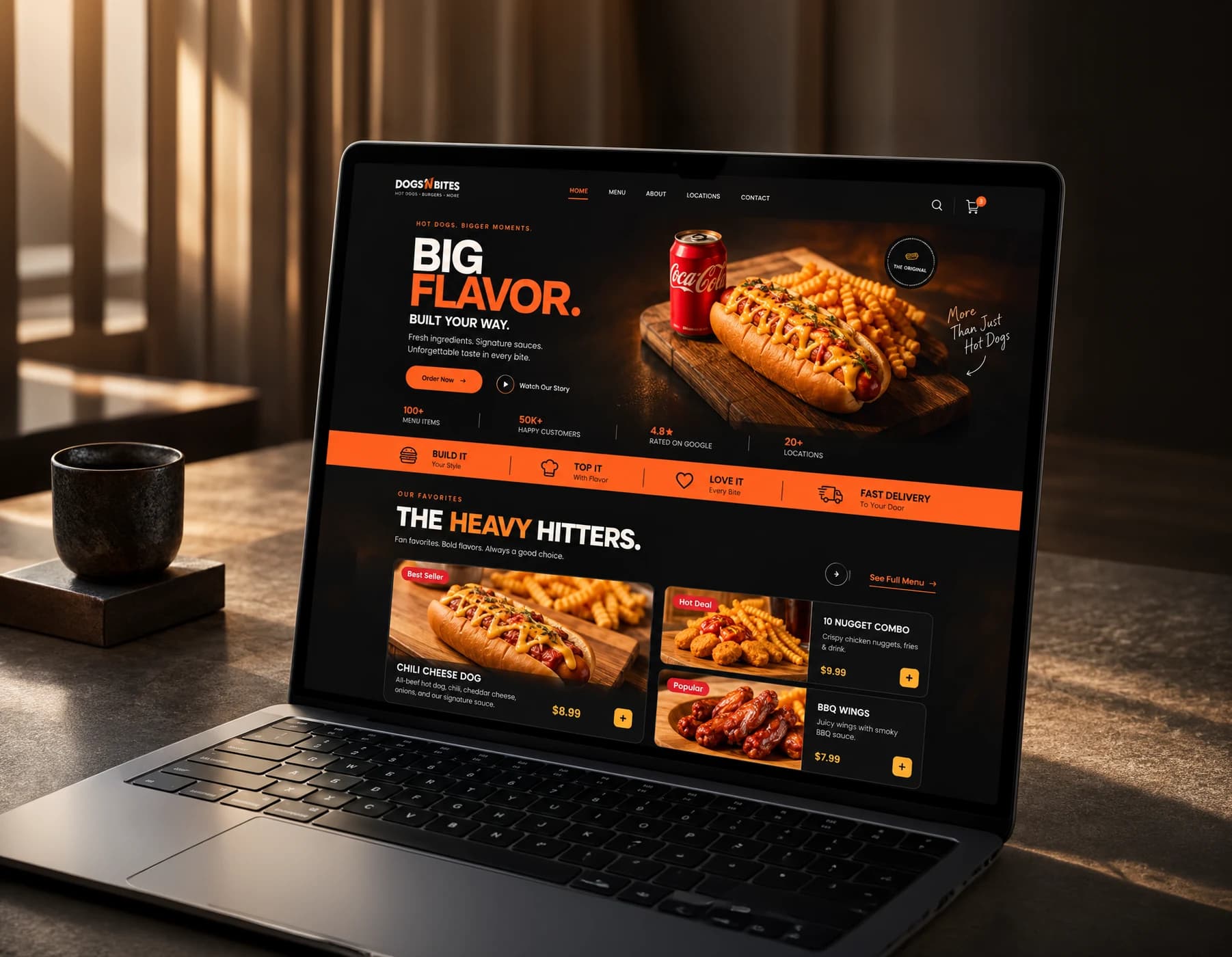
I designed a dark, high-contrast site with oversized condensed typography, vivid orange accents, cream text and gold highlights. An orange marquee reading ‘Build it. Top it. Love it.’ carries the street-food energy through the page.
The hero introduces ‘Big flavor. Built your way.’ alongside a floating signature-dog card and a Built fresh badge. From there, the structure leads into menu browsing and customization, keeping the brand's bold introduction connected to the practical details a customer needs.
04 · Key features
Key features
A full English/Korean switch supports the bilingual experience. The menu has seven categories: Build Your Own, Signature Dogs, Sliders, Fries, Wings & Nuggets, Kids, and Drinks & Extras, with prices in KRW. Category navigation gives the extensive selection clear entry points.
The ‘Build it your way’ guide separates premium toppings, free toppings, classic sauces and signature sauces, with a maximum of three sauces. A food photo gallery supports browsing. Open-now status and late-night hours use Korea Standard Time, while Naver Map, Kakao Map and Google Maps links sit alongside a copy-Korean-address button.
05 · Design decisions
Design decisions
The dark theme fits the late-night, comfort-food mood, while orange brings emphasis to headlines and actions. Cream text keeps the contrast clear without changing the overall character. Large type and category navigation make a long menu feel organized rather than treating every choice as one continuous list.
Naver and Kakao links give guests familiar local map options in Korea, alongside Google Maps. Copying the Korean address provides another practical way to use the location information. Those choices make the visit section useful to both local customers and people arriving from outside the area.
06 · Technical notes
Technical notes
The responsive layout serves English and Korean content. The live pages declare their respective document languages, use localized descriptions and provide reciprocal hreflang alternates between /en/ and /ko/, with an English default.
Project gallery